Showing posts with label Picture Books. Show all posts

2.06.2010

Picture Book 005: Al Columbia, PIM & FRANCIE

Fantagraphics · 2009

If it were ten years ago, I'd have been the first in line to buy this the morning it was released. A whole book by Al Columbia? Are you shitting me? After all these years?

But it's not ten years ago, it's now, and I've only checked it out of the library and will be returning it Monday morning. It's not that it's bad, that it's a disappointment, or even that Al Columbia is not still the supreme twisted genius he's always been; I've just reached a critical-mass point in my comics consumption where I can't afford to buy handsome hardcovers I'm not going to be returning to again and again.

And sadly, despite the fucked-up gorgeousness of the images Fanta has scanned, blown up, and lovingly curated in this book, I've read through it once and won't need it again. I'm a narrative guy, and while there are snatches and hints of narrative here, bleeding through the unfinished artwork and close-cropped panels, it's not enough to satisfy me.

But I did enjoy what I got. The title characters are the boy and girl on the cover, and Columbia makes them the Hansel and Gretel of his own private funhouse nightmares, old black-and-white Disney or Fleischer cartoons gone horribly awry. Dismemberment, eyes being gouged out, and the slick slice of razor against flesh are only a few of the repeated horrors committed upon Pim and Francie in varying states of cartooniness, a method which I'm sure a worthwhile critic could work up into a symbolism if they cared to try, but to my jaundiced eye reads more like the plain fact that this material was all drawn over a period of decades and a man's style is bound to change. It hardly matters, anyway: the book follows its own sinister dream logic, bouncing from zombie apocalypses to flesh-eating flowers to multi-limbed serial killers to horrific swing-dancing accidents with the manic glee of a Winsor McCay under psychiatric evaluation.

It wouldn't be an Al Columbia book if it wasn't incredibly frustrating: what's been published is clearly only a fragment of a vast body of material he's been working on off and on for years (the number of repeated images, sometimes only slightly tweaked, reveals the depth of his obssessive perfectionism), and the tantalizing glimpse of further panels just beyond the border of the page makes you wonder what this book might look like if he had followed through on what was clearly at one point a fully-fleshed narrative with its own mythology and characterization.

But on the other hand this nightmare collage may be more effective. Pim and Francie die horribly in many ways throughout the collection, and the reset button at the turn of each page follows the kind of logic that only dreams, of all the major narrative forms, ever achieve. The artwork is stunningly beautiful — his tight, slick brushwork and sense of composition is second to none — and the grisly imagery suitably depraved; I just can't help feeling that it's all going to dissipate inconsequentially the moment I wake up.

1.30.2010

Picture Books 004: Raymond Briggs, GENTLEMAN JIM

Drawn & Quarterly · 1980

The Comics Journal saved my life.

Okay, that's too melodramatic. And even if, in retrospect, I'm sure I would have found my way out of the aesthetic and moral dead zone which comic books at the close of 1998 had become for me, the Journal's list of the hundred best comics of the twentieth century (officious, elitist, and pugnacious as the Journal always was) blew in air from a clearer, more human country. Superheros had become my life, the only narrative form I was willing to consider. Sure, like many comics fans I gave lip service to the idea that comics was a medium and superheros only a genre, but it wasn't old Pogo and Tintin books that littered the carpet of my one-room. I was beginning to feel desperate, my dreams slipping away from me; if Vertigo didn't respond to my proposal for a serious, gritty take on Ultra the Multi-Alien, I would never be a writer.*

I think I first became aware of the Journal's list when some cantankerous denizens of the superhero-centric message board I mostly called home posted a link to gripe and cavill at. Only a handful of superhero titles! Jack Kirby (himself) no higher than #30! Magazine cartoons on a list of comics! It was the worst, most fraudulent exercise in humbug elitism yet perpetuated by those assholes and degenerates at Fantagraphics, Inc.

I stared thunderstruck at the list. Names I had almost forgotten washed over me, names from the Smithsonian Book Of Newspaper Comics which I had pored over in youth, checked out from the library again and again in order to watch Hu Shee save Terry Lee's life with a car and a revolver, puzzle over the long-dead slang employed by the raffish Moon Mullins and Barney Google, learn what sex was from Al Capp, and stare at the J. R. Williams panel cartoons so hard as to practically will myself to step into their lazy, nostalgic neverland. It was in that instant, though I wouldn't realize it for another five years, that the spell which superheros had cast over me in my late teens (something surely to do with sexuality and power and a weak sense of self) was broken. The day the 210th issue of the Journal came out, I bought it and devoured it. The first thing I bought after that was Seth's It's A Good Life If You Don't Weaken (#52 on the list).

(I cannot express how it altered my life. I was finally given permission to love all the old things I had always loved as a child — black-and-white movies, early comic strips, blues and jazz and ragtime, civilization built out of wood and stone with no plastic anywhere — but I was also, in Seth's sad chase after a fictive shadow, warned not to let nostalgia get the upper hand; love what you love, but think first. But all of this is nothing to the point.)

I began to steep myself in the history of cartooning, haunting used bookstores and snapping up old New Yorker cartoon collections, old newspaper strip collections, old comic books that did not feature superheros. I read allusive European art comics, flashy Japanese sci-fi comics, dry Canadian autobio comics and the weird, gross effusions of the underground. Most of the places I got my education from are no longer in existence; but one of the books that most thoroughly reoriented my outlook, and marked a subtle sea-change in all of comics even at the time, I bought at a national chain store which still does a roaring trade today. The store was Borders; the book was Ethel And Ernest by Raymond Briggs.

This isn't the place to go into a description of Ethel And Ernest; I'm six paragraphs in and haven't yet mentioned the nominal subject of this review. Suffice it to say that I consider it one of the four or five greatest works of art in the medium of comics, and reading it actually made me angry that the Journal hadn't waited until after the century was over to compile its list: how would the comics scavengers of the future be alerted to its presence? They needed this book. Well; I needed it, anyway. Its rich depiction of two ordinary, almost defiantly humble lives (the author's parents) set the standard for the vision of humanism which remains my most important criterion in evaluating art. The sickening self-satisfaction and meaningless eventness** of superhero — hell, nearly all — comics were intolerable after Ethel And Ernest.

So when Drawn & Quarterly republished one of Briggs' old books from the 1980s, there was no question but that I would snap it up. I'm pretty sure its purchase price set me in the red (that's true of about half the books I've really wanted for the past ten years), but just having it was enough. I didn't even read it. (Well, I tried once, on a long road trip. I've rarely been sicker.)

Gentleman Jim isn't Ethel And Ernest (very few books are), but as Seth's*** introduction notes perceptively, the dreamy, uneducated Jim Bloggs isn't a million miles away from Ernest, and simple, agreeable Hilda Bloggs is uncomfortably like Ethel. (If you've read or seen When The Wind Blows, it's the same couple again.) It's about as savage a caricature as Briggs seems capable of when dealing with people — the real target of his satirical scorn isn't Jim's rather stupid, Walter Mitty-esque attempts to live out a romantic fantasy, but the hyperlegalization of British life that has passed him by; officials and busybodies and superior persons of all sorts earn his ire. Though flipping back through the book it's not the dryly whimsical plot that stands out, but the fantasies, two-page spreads in gorgeous colors belying the drab hues of 1980 England.

But what's most fascinating that among the adventuresome fantasies Jim entertains — highwayman, cowboy, RAF pilot — is wedged the Executive, as seen in advertisements of the late 70s, all feathered hair and miles of brass. Briggs's sardonic point being that the illusion of wealthy competence is just another addled dream borrowed from the fantasy-merchants of television and magazines.

It's a beautiful book — Brigg's colored-pencil aesthetic was only bettered in Ethel And Ernest — but it is nevertheless slight, a brief fable of modernity that looks and reads so much like 1980 Britain that I half expect to hear the theme from Fawlty Towers as I close it. I'm glad to have read it, but I'm much more eager to see Briggs tackle another book for grown-ups.


*Sadly, nothing in this sentence was exaggerated for comic effect.

**By which I mean just one damn thing after another.

***Yes, him again.

1.23.2010

Picture Books 003: John Stanley, THIRTEEN GOING ON EIGHTEEN

Drawn & Quarterly · 1963-64

I'm not ordinarily a big fan of repeating names like this — when shuffling a playlist I get annoyed if two songs by the same artist show up twice in ten songs — but this arrived in the mail two days after I turned in my thoughts on Melvin Monster, and I devoured it immediately, so I might as well talk about it.

I think I first read the title Thirteen Going On Eighteen in one of Trina Robbins' many books on girls' comics; for whatever reason, the fulsome praise Robbins poured on the comic stuck with me, and I added the title to the mental list I kept when scrounging happily in back issue bins and dusty longboxes, lo these ten years and more agone. In the back of a bottom shelf of random Dell, Gold Key, and Valiant (there are always Valiant) comics in a huge vaultlike shrine to its now-deceased owner's pop-culture obsessions, I found a handful of issues; my memory suggests that I only bought one the first go-round, either because they were expensive (that is, upwards of two dollars) or because I wasn't sure I'd like it and had a lot of other stuff I wanted to check out too. Anyway, I definitely remember sitting in my car racking up minutes on the parking meter afterwards, slipping that issue (I think it was #22, but I'm not digging through my own longboxes to check) out of its mylar bag (gosh, remember mylar bags? all my comics purchases nowadays have spines) and reading it through in one delicious gulp.

Which is exactly how I read this big slab of fake newsprint, in one sitting, my smile getting bigger as the comic I knew struggled out of its first halting drawn-by-some-other-guy issues and into the whip-smart, manic, bitchy, and surreal series it was for the most glorious run in teen comics history, twenty issues and out. My collector's impulse is sporadic and lazy; I'd only read about half the material in the book before, but it's been years since I revisited it and it's better than I remembered, and I remembered it as my favorite comic book series ever.

I talked about Stanley's strengths as a cartoonist and writer last time, but I want to emphasize again my conviction that there has rarely been a better cartoonist in terms of pacing, structure, and dialogue, especially in stories this ephemeral and fleeting. Thirteen Going On Eighteen is a "teen comic" in the vein of Archie or Marvel's Patsy Walker, but thanks to Stanley's loose, cartoony art and down-to-earth, sarcastic wit it's neither as visually glamorous nor as goofily brain-dead as teen comics nearly always are. Val and Judy are supposed to be thirteen, and though after a bit they simply occupy the generalized "eternal teenager" zone of Archie, they're never sexualized in the way that Betty and Veronica nearly always were from Dan DeCarlo on down: Stanley is too true to his own comic vision of frustration and ineptitude for that. His characters are fully-rounded comic creations: delusional, irritable, quick to fight and forgive, self-dramatizing, and manipulative in ways that leave the blank, unmotivated conflict-followed-by-bonhomie of the Archie universe in the dust.

As series editor and designer Seth puts it in his introduction: "Can you imagine Reggie sitting in his room alone? What would he be thinking?" Whatever the scriptwriter needed him to be thinking to advance whatever ridiculous plot he's involved in, of course; but when Stanley's Val or Judy sits alone and thinks, it's both psychologically true and funny all through.

It would be nearly impossible for me to oversell the quality of this work. The only complaint I can make is that since this volume collects the first nine issues it doesn't cover the series' peak yet, but it's good all the way through. And I suppose if you have something against teen comics, or comic books period, or unambitious situation comedy in general, you might dislike it. But as someone who has attempted to put brush to paper, wrestled with issues of pacing and rapid-fire dialogue, and accidentally knocked over inkstands, blotting out hours of work at a go -- that is, as someone who's tried to be a cartoonist — John Stanley is an inspiration, a standard to live up to, and a hero. I read him in the same way a studio musician might listen to jazz: for the sheer pleasure of seeing it all so competently done.

1.17.2010

Picture Books 002: John Stanley, MELVIN MONSTER

Drawn & Quarterly · 1965

John Stanley is one of the greatest pure cartoonists in history, a man who could both draw funny things and draw things funny, with a loose, bold line that was perfect for the squalid, ugly reproduction of comic books in the days when they cost a dime and their natural state was rolled up and sticking out of some kid's back pocket.

This gorgeous archival volume reprinting the first three issues of Stanley's goofy sendup of the 60s monster craze feels a bit overdone, given the grubby whiz-bang-rimshot of its contents. Which isn't to say that Stanley was a mediocrity; even this, the least of his 60s work on his own (the holy grail for Stanley fans, the complete Thirteen Going On Eighteen, has its first volume due out this week, and I'm dropping my no-new-purchases rule to score a copy), is admirably zany, zipping from punchline to punchline without stopping for breath. I'd read two-thirds of the book before, since I own two of the original issues; but the entire thing was still a joy to swallow in a single-sitting gulp, a model of pacing that any cartoonist who wants to create the illusion of continuous action would do well to study.

I called it a sendup of the 60s monster craze, but it feels more like a sendup of the sendups. It takes the comedy-of-inversion of The Addams Family and The Munsters to its logical conclusion: rather than loving little Melvin, his monster parents hate him and want to kill him; the family's pet crocodile tries to eat him at every turn; the neighbors hate him because he doesn't throw rocks through their windows; and so forth. It's an opportunity for Stanley, who could be extremely perceptive about the deception and compromise endemic to human community (you have read some Little Lulu, right?), to create a wholly amoral world, in which Melvin wanders around as a holy fool, utterly indestructible and too innocent (or stupid) to see anything except in the best light possible.

Or if you don't want to think of it as a meditation on free-market capitalism proceeding in its logical way to anarchy (no institution in the monsters' world is reliable, least of all the "guardian demon" system which functions mostly as a plot device), you can just laugh at the jokes. And there are lots of them, though really only the ones that proceed from character and action work; unless you're a small child and lines like "I can't boolieve my ears" are screamingly funny. This stuff was after all aimed at small children. But even the page containing that horrible pun ends with the merciless thrashing of a character who can boolieve his ears (because they're huge); the world of Melvin Monster is satisfyingly violent, and I could buy an argument that it was an outlet for Stanley to at last get out some of his darker, more boyish impulses after a decade of (not particularly girly) comics for little girls.

Like I said, Melvin Monster is the least of Stanley's great 60s comics. He was better at straight humor than at satire — Melvin's satirical adventures keep getting interrupted by flights of sheer lunacy — and in another life he could have made an excellent sitcom writer, if sitcoms were ever as personal and singular as comic books at their best can be.

1.10.2010

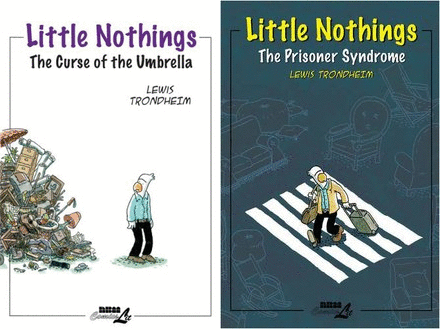
Picture Books 001: Lewis Trondheim, LITTLE NOTHINGS

NBM · 2006-2007

Sorry; this was supposed to be a Saturday thing. Minor though persistent illness and a gnawing feeling of having bitten off more than I can chew have kept me mostly silent all weekend. On the plus side, I've caught up on my Hulu viewing, amused myself in the usual ways one does online, and rested enough to make sure my health is ready to cope with another work week; on the minus, a wholly arbitrary schedule I set for myself has been knocked askew. Guess which one matters to me more.

Somehow I think Lewis Trondheim would relate. He's been chronicling the petty aggravations, pop-culture fantasies, and minor triumphs of an obssessive-complusive, paranoid, superstitious, and reluctantly adult bird-man named Lewis Trondheim for most of the decade at his website. So far four volumes of his "petits riens" have been published in French; with the usual lag in translation, two volumes in English have so far turned up.

It's probably appropriate to add here that Lewis Trondheim is one of my personal heroes (the only other living one is Paul F. Tompkins), my most direct inspiration to take up pen and ink and try to cartoon at all. His deceptively basic approach to cartooning, with simplified animal figures standing in for humans, was a breath of fresh air when I discovered the two volumes of Lapinot that Fantagraphics had translated into English at the end of the 90s; his shaggy-dog approach to storytelling, which involves just as much hanging out with friends and petty arguing as plotting, helped to rescue me from the idea that for comics to be great they had to take themselves seriously, and his refusal to be bound by the laws of time and space (each volume of Lapinot involves the same characters but takes place in a different historical era) has, now that I think about it, probably influenced my worldview and critical infrastructure more than any other single work.

But we're talking here about Little Nothings. As someone who has wrestled however ineptly with volume, line, and shape, I still deeply admire Trondheim's chicken-scratch solutions to those problems, his loose line filling in details without cluttering up the page, the European tradition of clear-line cartooning retaining its elegance even as Trondheim presents a modern Europe (and everywhere else) which has degenerated and scuzzed over since the era of Hergé. He's only grown in confidence and ability since the era when I fell in love with him, as the increasingly gorgeous watercolor washes behind his thin, unsteady line demonstrate.

These books are an determinedly minor entry in Trondheim's bibliography — although, ever since Lapinot ended, they're very nearly the only thing he's done all by himself, without scripting for others or having a rotating cast fill out his sketches. This isn't necessarily a bad thing — all of his collaborators, nearly without exception, are also great cartoonists — but it means that those of us who jones for the uncut Trondheim will have to be satisfied with these minor observations and quick sketches capturing a single mood. He's frequently very funny; but it's the quotidian humor of everyday life, of minor inconsistencies and anecdotes traded over a few too many glasses. For the uncut Trondheim on a more epic scale, I'll have to turn to Lapinot.

Which I will. But since it's still (mostly) in French, I'll have to wait for when I'm feeling better. I don't know about you, but I can't translate on the fly from a language I've never formally studied when I'm sick.

I'll leave you with this. From NBM's blog, one of the more beautiful single-page strips from the second volume: